
Student Outcomes and Continuous Enhancement
City of London College is committed to delivering positive student outcomes through effective governance, evidence-informed decision-making and a culture of continuous enhancement. The College recognises that student success is the ultimate measure of institutional effectiveness and that sustained improvement is achieved through meaningful collaboration between students, staff, Governors and external stakeholders.
Student outcomes are considered within the broader context of academic quality, learning and teaching, student engagement, wellbeing, employability and institutional performance. Through systematic monitoring, evaluation and review, the College seeks to ensure that every student is provided with the opportunities, support and resources necessary to achieve their academic, professional and personal aspirations.
The College places students at the centre of institutional planning, recognising that successful outcomes are the result of high-quality academic provision, effective student support and robust governance.
Monitoring Student Outcomes
The College regularly monitors a range of indicators that provide insight into the effectiveness of its academic provision and the overall student experience.
Monitoring may include consideration of:
- student continuation;
- completion and achievement;
- academic attainment;
- progression to further study or employment;
- graduate outcomes;
- student engagement and participation;
- attendance and retention;
- student satisfaction; and
- other institutional performance indicators.
These measures are considered collectively to provide a comprehensive understanding of student success and institutional effectiveness, enabling the College to identify strengths, emerging risks and opportunities for enhancement.
Evidence-Informed Enhancement
Continuous enhancement is supported by a wide range of institutional evidence gathered from across the College.
This evidence includes:
- student feedback and consultation;
- Student Representative and Student Board contributions;
- academic monitoring and annual review;
- awarding organisation and external examiner reports;
- quality assurance activities;
- regulatory developments;
- employer and stakeholder engagement;
- institutional performance data; and
- examples of recognised sector good practice.
This integrated evidence base enables the College to evaluate performance objectively, respond proactively to emerging issues and implement improvements that strengthen student outcomes and institutional effectiveness.
Governance and Strategic Oversight
The College’s Governance Framework provides strategic oversight of student outcomes and continuous enhancement.
The Board of Governors, Academic Board and relevant committees receive regular reports relating to:
- academic quality and standards;
- student performance and progression;
- quality assurance and enhancement;
- student engagement;
- institutional performance; and
- strategic risks affecting the student experience.
This oversight enables Governors and senior leaders to monitor progress against strategic objectives, evaluate institutional performance and ensure that enhancement activities remain aligned with the College’s mission, regulatory responsibilities and commitment to academic excellence.
Learning and Continuous Improvement
Continuous enhancement is embedded throughout the College’s governance, academic governance and quality assurance arrangements.
Lessons arising from:
- academic review;
- student engagement;
- complaints and appeals;
- external scrutiny;
- stakeholder engagement;
- institutional evaluation; and
- performance monitoring
are used to inform future planning, policy development, curriculum enhancement and strategic decision-making.
This integrated approach strengthens organisational resilience, supports innovation and enables the College to respond effectively to the changing needs of students and the higher education sector.
A Culture of Student Success
City of London College is committed to creating an environment in which every student could succeed academically, develop personally and progress confidently to the next stage of their education or career.
Student success is viewed not only as an individual achievement but also as a reflection of the effectiveness of the College’s governance, leadership, academic quality and commitment to continuous enhancement.
The Student Voice, Engagement and Representation Framework demonstrate the College’s commitment to partnership, accountability and continuous improvement. Through effective representation, meaningful engagement, constructive feedback and collaborative enhancement, students make a significant contribution to shaping the future development of the College.
Together, students, staff, Governors and external partners create an academic community that is committed to excellence, innovation and the achievement of positive outcomes for all learners.
Related Documents
- Student Engagement Framework
- Student Charter
- Quality Assurance Framework
- Academic Governance Framework
- Access and Participation Plan (where applicable)
- Student Protection Plan
- Annual Quality Report (when published)
- Annual Student Experience Report (when published)
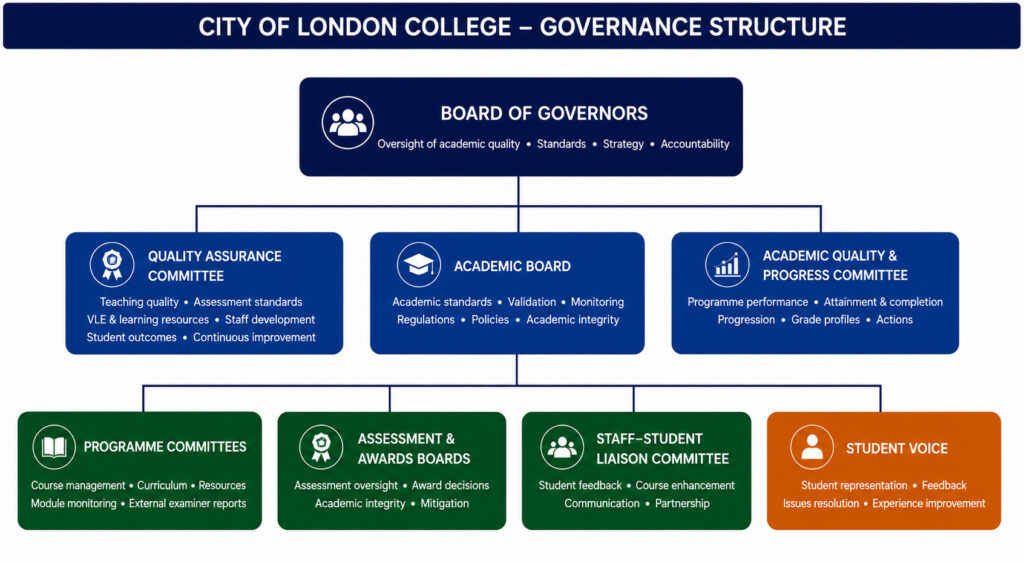
The Academic Governance Framework establishes clear reporting lines and responsibilities for academic decision-making, quality assurance, student outcomes monitoring and enhancement activities.
The framework ensures that academic assurance is provided to the Board of Governors through structured review, monitoring and reporting arrangements. Academic governance operates independently of day-to-day management while maintaining close working relationships with academic and professional services teams across the College.
Academic Board
As the College’s principal academic authority, the Academic Board provides academic assurance to the Board of Governors and supports informed decision-making on matters affecting students, programmes and academic quality. It is responsible for overseeing academic standards, the quality of learning opportunities and the continuous enhancement of the student academic experience.
The Academic Board provides strategic leadership for academic matters and receives assurance from committees and academic teams regarding programme performance, assessment outcomes, student achievement, progression, retention and academic quality.
Key responsibilities include:
- Maintaining academic standards.
- Monitoring academic quality and student outcomes.
- Approving academic policies and procedures.
- Reviewing programme performance and enhancement activities.
- Overseeing assessment and progression arrangements.
- Monitoring student engagement and academic support.
- Considering recommendations arising from quality assurance activities; and
- Providing academic assurance to the Board of Governors.
Quality Assurance and Academic Standards
The College operates a structured approach to quality assurance designed to maintain the integrity and consistency of its academic provision.
Quality assurance activities include:
- Programme monitoring and review.
- Assessment oversight.
- External examiner engagement where applicable.
- Academic policy review.
- Student feedback analysis.
- Annual monitoring and evaluation activities.
- Review of learning resources and student support arrangements; and
- Continuous improvement planning.
These arrangements help ensure that programmes remain academically rigorous, aligned with relevant regulatory and awarding body requirements, and capable of delivering positive outcomes for students.
Academic Quality, Progression and Enhancement
The College is committed to ensuring that students are supported to achieve successful academic outcomes and make meaningful progress throughout their studies. Academic governance therefore extends beyond the maintenance of academic standards and includes active monitoring of student achievement, progression, retention and the overall effectiveness of the learning experience.
Through its academic governance arrangements, the College regularly reviews information relating to:
- Student achievement and attainment.
- Student progression and continuation.
- Assessment performance and trends;
- Student engagement and participation;
- Graduate outcomes where applicable;
- Student feedback and satisfaction; and
- The effectiveness of academic and support interventions.
This information enables the College to identify areas of good practice, respond to emerging risks and develop targeted enhancement activities that support student success.
Where opportunities for improvement are identified, action plans are developed, implemented and monitored through the academic governance framework. Progress against these actions is reviewed regularly to ensure that improvements lead to positive outcomes for students and contribute to the continuous enhancement of academic provision.
The College seeks to foster a culture of evidence-based decision-making, continuous improvement and shared responsibility for student success across all areas of academic activity.
Student Voice and Representation
Students play an important role within the College’s academic governance arrangements.
The College actively encourages students to contribute to the development and enhancement of academic provision through a range of formal and informal mechanisms.
These include:
- Student representatives.
- Student feedback surveys.
- Programme-level discussions.
- Staff-student engagement activities.
- Student participation in governance processes; and
- Student consultation on academic and support matters.
Student feedback and representation are integral components of the College’s academic governance arrangements. Students contribute to discussions regarding programme quality, learning resources, student support and the wider academic experience through established representation and engagement mechanisms.
Student feedback is reviewed regularly and informs decision-making across academic and student support functions.
The College is committed to ensuring that students have meaningful opportunities to influence the development of their educational experience.
Reporting and Accountability
The Academic Governance Framework operates through a system of regular monitoring, reporting and review.
Information relating to academic quality, standards, student outcomes and enhancement activities is considered through the academic governance structure and reported to the Board of Governors through established governance arrangements.
This process provides assurance that:
- Academic standards are maintained.
- Students receive a high-quality educational experience.
- Risks to academic quality are identified and managed.
- Student outcomes are monitored and improved; and
- Academic policies and procedures remain effective and fit for purpose.
Through these arrangements, the College seeks to maintain a culture of continuous improvement, accountability and academic excellence.
Commitment to Continuous Improvement
Academic governance at City of London College is designed not only to maintain standards but also to drive continuous enhancement. Through regular monitoring, review and evaluation, the College seeks to identify opportunities for improvement, respond to student feedback and ensure that academic provision remains relevant, effective and aligned with the needs of students, employers and the wider higher education sector.
Related Documents
Further information regarding the College’s academic governance arrangements, student engagement processes and quality assurance framework can be found in the documents below.
- Academic Governance Framework.
- Governance Framework.
- Student Charter.
- Student Engagement Framework.
- Student Complaints Policy.
- Appeals and Complaints Procedures.
- Access and Participation Statement; and
- Quality Assurance and Enhancement Policies.