
Academic Governance Framework
Academic Governance Narrative
Academic Governance Structure (Diagram 2)
Academic Governance Framework
City of London College is committed to delivering a high-quality educational experience that enables students to achieve their academic and professional ambitions. Academic governance provides the framework through which the College safeguards academic standards, monitors student outcomes, promotes continuous improvement and ensures that students remain at the centre of academic decision-making.
The College’s Academic Governance Framework provides oversight of academic quality, standards, student outcomes and continuous improvement. It operates alongside the corporate governance arrangements of the Board of Governors and ensures that academic matters receive appropriate scrutiny, challenge and independent oversight.
Academic governance is founded on the principles of academic integrity, student-centred decision-making, evidence-based review and continuous enhancement. Through its committees, academic leadership teams and student representation arrangements, the College seeks to ensure that programmes remain relevant, academically rigorous and responsive to the needs of students, employers and awarding partners.
Executive and Operational Structure
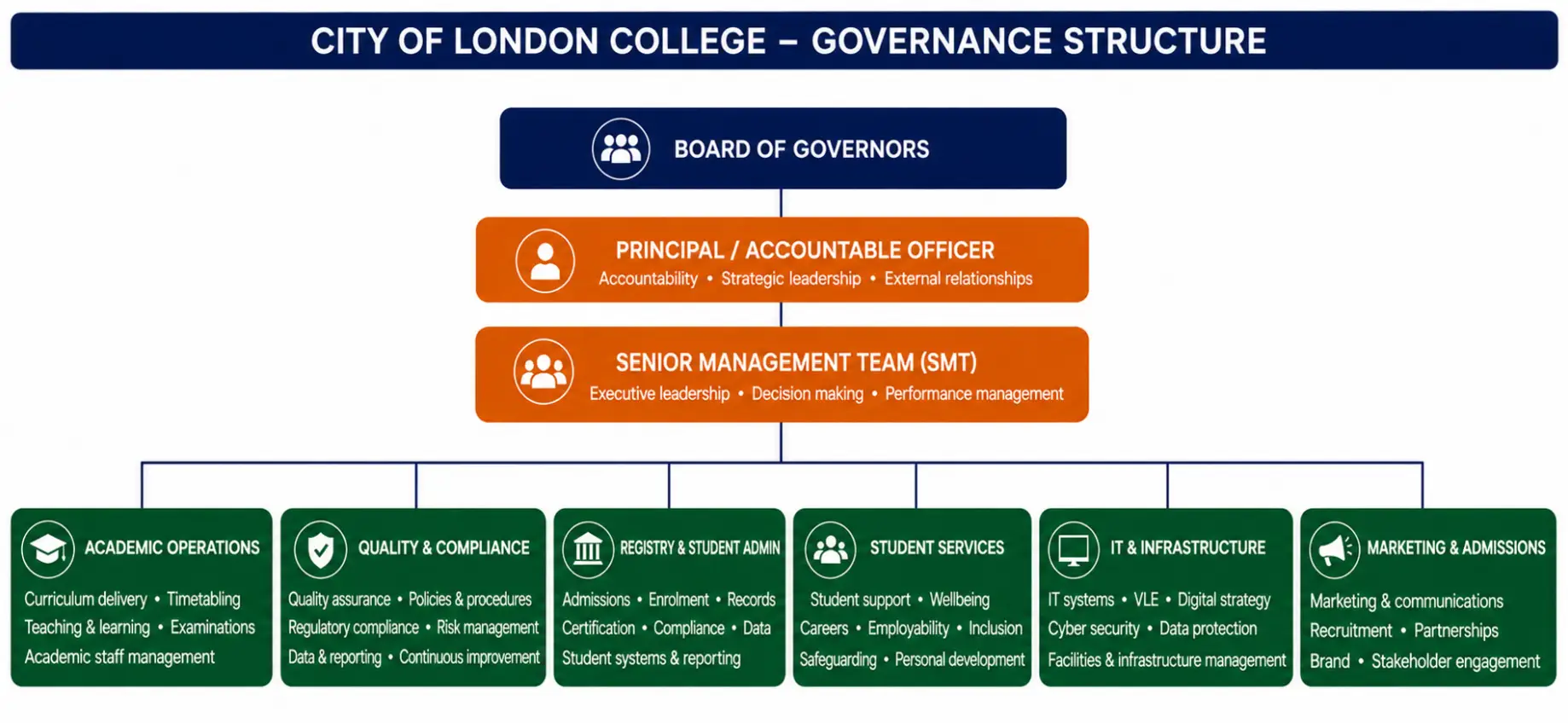
The Executive and Operational Structure establishes clear lines of accountability and responsibility across the College. It supports effective decision-making, operational oversight and the coordinated delivery of academic and professional services.
The structure ensures that responsibilities are clearly defined and that all areas of the College contribute effectively towards achieving the institution’s strategic objectives.
Leadership and Accountability
The Executive and Operational Team is accountable for the effective management and operation of the College. It provides leadership across academic, administrative and support functions and ensures that institutional activities are aligned with the strategic direction approved by the Board of Governors.
The Team regularly reviews performance, monitors key risks and oversees the implementation of policies, procedures and strategic initiatives. Through these activities, it supports effective governance, operational effectiveness and institutional accountability.
Senior managers provide reports and recommendations to the Board of Governors and contribute to the monitoring of institutional performance, financial sustainability, student outcomes and regulatory compliance.
Through regular reporting arrangements, the Executive and Operational Team provides assurance to the Board of Governors and supports informed decision-making across the College.
Academic Leadership
Academic leadership is central to the College’s mission of delivering a high-quality educational experience.
Working closely with the Academic Governance Framework, academic leaders are responsible for supporting programme delivery, curriculum development, assessment management and academic enhancement activities. They play an important role in ensuring that academic standards are maintained and that students receive the support necessary to achieve positive outcomes.
Key areas of responsibility include:
- Programme delivery and oversight;
- Curriculum development and review;
- Assessment and feedback processes;
- Academic staff development;
- Student academic support;
- Monitoring academic performance; and
- Supporting quality enhancement activities.
Student Support and Experience
The College is committed to creating a supportive and inclusive environment in which students can succeed academically and personally.
Professional and academic staff work together to provide a range of services designed to support students throughout their educational journey. These services contribute to student wellbeing, engagement, achievement and progression.
Support activities may include:
- Admissions and enrolment;
- Student welfare and pastoral support;
- Academic guidance and advice;
- Learning support services;
- Student engagement activities;
- Complaints and appeals support; and
- Access and participation initiatives.
The College continually reviews these services to ensure that they remain effective, accessible and responsive to student needs.
Quality, Compliance and Risk Management
The Executive and Operational Structure establishes clear lines of accountability and responsibility across the College. It supports effective decision-making, operational oversight and the coordinated delivery of academic and professional services.
The structure ensures that responsibilities are clearly defined and that all areas of the College contribute effectively towards achieving the institution’s strategic objectives.
Team plays an important role in ensuring that the College operates in accordance with its legal, regulatory and contractual obligations.
This includes oversight of:
- Regulatory compliance;
- Quality assurance processes;
- Risk management;
- Data protection and information governance;
- Financial management and sustainability;
- Policy implementation and review; and
- Continuous improvement activities.
Through regular monitoring and reporting, the College seeks to identify emerging risks, maintain compliance and support informed decision-making.
Partnership and External Engagement
The College works closely with awarding organisations, professional bodies, employers and other external stakeholders to support the quality and relevance of its educational provision.
Senior managers maintain relationships with these partners and ensure that the College remains responsive to developments within higher education, professional practice and the wider employment market.
These relationships help support programme quality, student opportunities and the continued development of the College’s academic offer.
Continuous Improvement
The Executive and Operational Structure establishes clear lines of accountability and responsibility across the College. It supports effective decision-making, operational oversight and the coordinated delivery of academic and professional services.
The structure ensures that responsibilities are clearly defined and that all areas of the College contribute effectively towards achieving the institution’s strategic objectives.
Team promotes a culture of continuous improvement across all areas of the College.
Through regular review, evaluation and planning activities, the College seeks to enhance operational effectiveness, improve the student experience and strengthen institutional performance.
Continuous improvement activities help ensure that services remain responsive, resources are used effectively and opportunities for development are identified and acted upon in a timely manner.
Related Documents
Further information regarding the management and operation of the College can be found in the following documents:
- Governance Framework;
- Academic Governance Framework;
- Strategic Plan;
- Risk Management Framework;
- Student Charter;
- Student Engagement Framework;
- Access and Participation Statement; and
- Relevant College policies and procedures.